Storm Preparation
Tie-downs, extra lines, fender placement, canvas securing, and coordination with your marina. Ocean City and the Eastern Shore. Because the time to prep is before the forecast turns red.
Atlantic coast storms are real. A nor'easter or hurricane can turn a secured boat into a disaster if the prep work wasn't done right. Lines snap. Fenders shift. Canvas rips free. A boat that looked fine at the dock on Monday can be sitting on the bottom by Wednesday.
The problem is timing. Most boat owners don't live at the marina. When a storm is 48 hours out, you're at work, hours away, or out of town. And by the time you can get there, the marina is chaos. Everyone is scrambling at once. Dock hands are overwhelmed.
That's where having someone local matters. I'm based on the Eastern Shore. When a storm enters the forecast, I can get to your boat and handle the prep work while you're still watching the weather channel from your living room. Double lines, check fenders, secure canvas, inspect through-hulls. The boat rides it out. You don't have to make a panicked drive at midnight.
After the storm passes, I go back. I check the boat, document the condition, and send you photos. If something went wrong, you know about it immediately instead of finding it two weeks later on a Saturday morning.
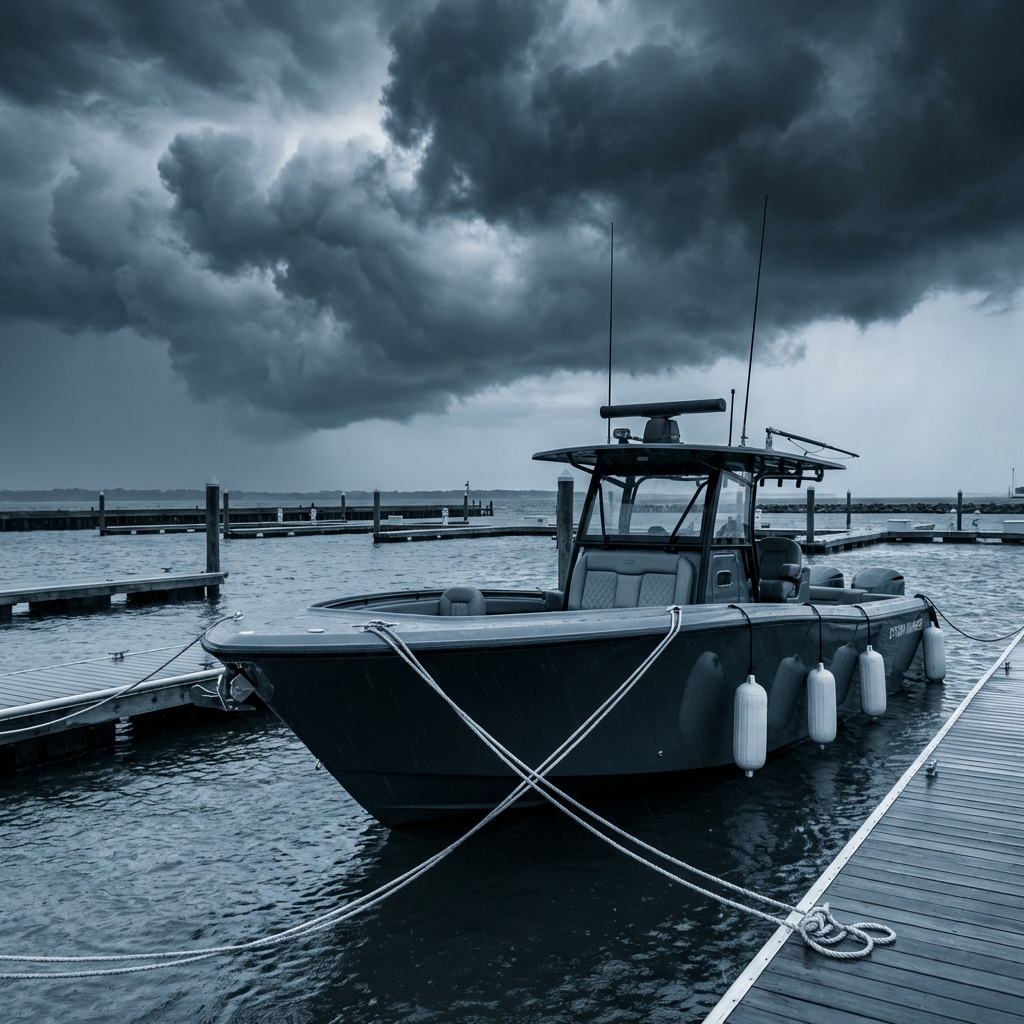
Every boat and every storm is different, but this is the baseline
Extra lines added with proper chafe protection at every contact point. Spring lines adjusted for surge. Line angles set based on predicted wind direction.
Fenders repositioned and additional fenders added for surge height and expected wind direction. Standard fender placement isn't enough when water rises 2-4 feet above normal.
Eisenglass and canvas panels either removed and stored or strapped down with heavy-duty ties. Loose canvas in 60+ mph wind becomes a sail or a projectile.
Bimini tops folded and strapped. T-top accessories removed or tied down. Antennas, outriggers, and anything that catches wind gets addressed.
Every through-hull inspected. Seacocks confirmed closed where appropriate. Bilge pumps tested and batteries verified. If the bilge pump fails during a storm, the boat fills.
After conditions clear, I do a full walkthrough with photo documentation. You get a report of the boat's condition and any damage that needs attention, sent directly to your phone.
Most owners can't get to the marina on short notice. Work, family, distance. I'm local and I get there fast. Your boat gets prepped whether you can make the trip or not.
Line angles, chafe guards, fender height, spring lines. The details matter when 60 mph gusts show up. A quick tie-off isn't storm prep. Proper prep is methodical and specific to each boat and each storm.
After the storm passes, I check the boat and send you photos. If there's damage, you know immediately. Not two weeks later when you finally get to the marina and find a problem that's been getting worse.
I talk to the dock master, coordinate haul-out if needed, and make sure nothing falls through the cracks. If the marina has specific storm protocols, I follow them. If they need someone to relay info to you, I handle that too.
I reach out to scheduled clients with a heads-up as soon as a storm system looks like it's heading our way. No waiting for a hurricane warning. Early awareness means better prep.
Lines doubled and crossed, fenders repositioned for surge, canvas secured or removed, batteries disconnected if needed. Everything checked and documented before the weather arrives.
I monitor conditions throughout the event and check in at the marina when it's safe to do so. If something needs immediate attention during a break in the weather, I'm close enough to act.
After the storm, I assess the boat, send photos, and handle any immediate issues. Lines adjusted back to normal, fenders repositioned, canvas reinstalled. If there's damage, I coordinate repairs or connect you with the right people.
I serve marinas from the Delaware coast down through Ocean City and the back bays. If your boat is docked somewhere in this area, I can get to it when a storm is coming.
Atlantic hurricane season runs June through November. Nor'easters hit October through April. On the Eastern Shore, storm prep isn't just a summer concern.
How far in advance do you need notice?
As much as possible. Ideally 48-72 hours before a storm, but I've prepped boats on shorter notice when needed. The earlier the call, the more thorough the prep. If you're on my storm prep list, I'll reach out to you first anyway.
Do you work with all marinas in the area?
I work at most marinas between Delaware and Ocean City. Some marinas have specific rules about storm prep, and I know most of them. If I haven't worked at your marina before, I'll call ahead and sort out access and requirements before the storm hits.
What about after the storm?
I go back as soon as it's safe and do a full walkthrough. You get photos and a summary of the boat's condition. If anything needs immediate attention, I handle it or coordinate with the right people. You shouldn't have to wonder how your boat made it through.
Can you haul the boat out before a major storm?
If the forecast calls for it, yes. I coordinate with local yards for haul-out and blocking. This needs more lead time, so the earlier you decide, the better the chances of getting a spot. Yards fill up fast once a major hurricane is in the forecast.
Tell me about your boat and where it's docked. When a storm enters the forecast, you'll already have someone ready.
Put me on your storm prep list now. When the forecast changes, you'll already have someone ready.
Contact for Quote (302) 853-2853 jacob@catalystmarineservices.com100T USCG Near Coastal Captain | Starke Yacht Care Certified | Ocean City, MD